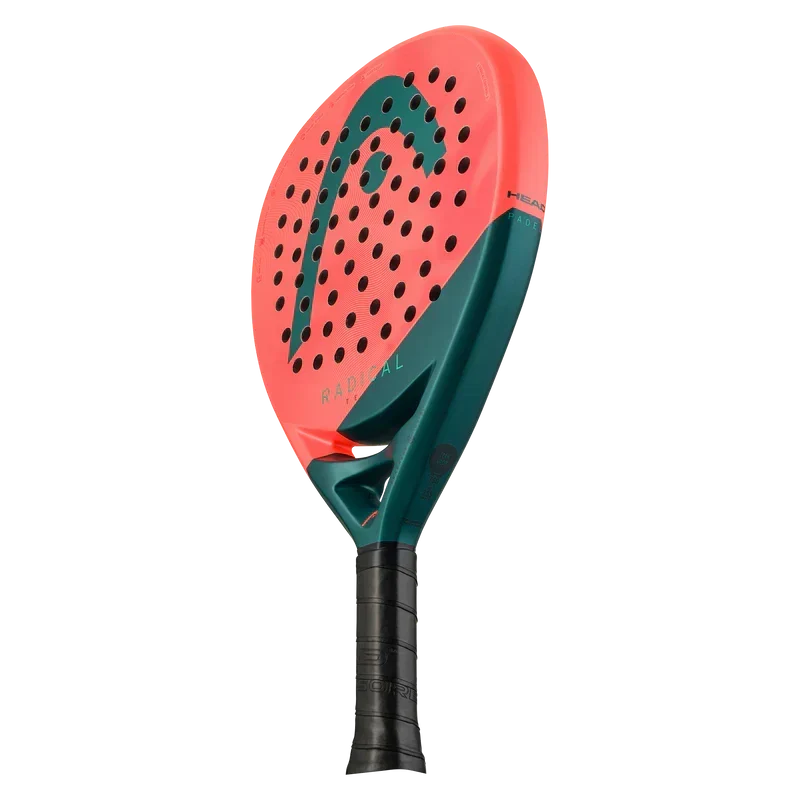

Quick answer: Padel rackets come in three shapes. Round rackets have a low, central sweet spot and give the most control, so they suit beginners and defensive players. Teardrop rackets sit in the middle, balancing control and power for most club players. Diamond rackets put the sweet spot high on the head for maximum smash power, but they are less forgiving and best left to experienced, attacking players.
Walk into any padel club in the UK and you will see all three shapes on court, often in the same game. Shape is the single biggest thing that changes how a racket feels, more than brand or price. Get it wrong and a £200 racket will feel worse than a £60 one. This guide explains what each shape does, who it suits, and how to choose, based on what we see every week fitting players at Central Tennis.
Round vs teardrop vs diamond: the comparison at a glance
| Shape | Sweet spot | Balance | Control | Power | Best for |
|---|---|---|---|---|---|
| Round | Low, centre, large | Low (head-light) | High | Lower | Beginners, defenders, tennis converts with elbow worries |
| Teardrop | Middle to slightly high | Medium | Medium-high | Medium-high | Improvers and most club players |
| Diamond | High, smaller | High (head-heavy) | Lower | High | Advanced, attacking net players |
The rule of thumb: the higher the sweet spot sits on the head, the more power you get from a full swing, and the less you get away with an off-centre hit.
Round padel rackets: control and forgiveness

A round racket has its sweet spot in the centre of the face and most of its weight close to the hand. That low balance makes it quick to move at the net, easy to manoeuvre in fast exchanges, and gentle on the arm. Mishits still go back over the net, which is exactly what a new player needs while learning to read the glass.
The trade-off is smash power. Because there is less mass at the top of the head, flat smashes and por tres attempts need more work from your technique. Most players do not miss that in their first year, because padel points are won far more often with patient lobs, volleys and bandejas than with winners.
Choose round if: you are new to padel, you play mostly from the back of the court, you have had tennis elbow, or you value placement over pace. Our best padel rackets for beginners guide is almost entirely round rackets for this reason.
Teardrop padel rackets: the all-rounder

A teardrop (sometimes sold as "hybrid") narrows towards the throat and widens at the top, lifting the sweet spot slightly above centre. The result is a medium balance: more pop on smashes and volleys than a round racket, but still enough forgiveness to defend from the back glass.
This is the shape most club players settle on, and the one most brands put their best technology into. If you play two or three times a week, you are comfortable with the walls, and you have started to attack the net, a teardrop is usually the right next racket. Many players also find it the easiest shape to play both sides of the court with, which matters if your partner changes from week to week.
Choose teardrop if: you are moving on from a beginner racket, you switch between defending and attacking, or you are unsure. When in doubt, a teardrop is the safest buy. See our best padel rackets for intermediate players for more options.
Diamond padel rackets: power for attackers

Diamond rackets are widest near the top, with a high, smaller sweet spot and a head-heavy balance. That extra mass at the tip turns a well-timed smash into a winner and adds weight to volleys at the net. It is the shape you see in the hands of many professional left-side ("revés") players who finish points overhead.
The cost is control and comfort. Off-centre hits lose a lot of pace, the racket feels slower in quick net exchanges, and the head-heavy balance puts more load on the wrist, elbow and shoulder. Diamonds reward clean technique and punish poor timing.
Choose diamond if: you are an experienced player with a reliable overhead, you play the left (revés) side and finish points, and you have no history of arm injuries. If you are not sure whether you are ready, you probably are not yet.
Shape is only part of the story: balance, weight and core
Two rackets with the same shape can feel completely different. Before you buy, check three more specs:
- Weight: most adult rackets sit between 350g and 375g. Lighter (around 350-360g) is easier on the arm and faster at the net; heavier adds stability and power.
- Balance: listed as low, medium or high. It usually follows the shape, but a "light" or "LS" version of a diamond can play closer to a teardrop.
- Core and face: soft EVA or foam cores give more ball exit at slow swing speeds and are more comfortable; hard EVA gives more control for strong hitters. Fibreglass faces feel softer and more forgiving, while carbon faces are stiffer and more precise.
Grip size matters too. Our padel grip guide explains how to build a handle up with overgrips so it fits your hand.
Which shape is best for you? A simple decision guide
- First year of padel, or coming from tennis or squash: round.
- Playing regularly, comfortable with the walls, starting to attack: teardrop.
- Advanced left-side player with a strong smash: diamond.
- Elbow, wrist or shoulder problems at any level: round, or a light teardrop with a soft core.
- Junior players: round, in a dedicated junior weight.
Whatever you choose, look after it. Our padel racket care guide covers storage, frame protectors and when to replace a racket.
Our picks at Central Tennis
All in stock at the time of writing, with one or two per shape so you can compare like for like.
- Round: BullPadel Open Control Padel Racket - Grey (£64). A round, head-light, forgiving racket that makes a sensible first purchase.
- Round: Babolat Counter Vertuo 2.6 Padel Racket (£144). A round, fibreglass-faced control racket at around 350g, for improving players who still want comfort.
- Teardrop: HEAD Coello Vibe 2026 Padel Racket (£84.99). An oversize teardrop head with a large sweet spot at 355g, and great value for players stepping up from round.
- Teardrop: HEAD Radical Team 2026 Padel Racket (£95.16). A teardrop with low balance at 360g that gives versatility without a harsh feel.
- Diamond: Aixo Insane Bolt Padel Racket 18k Carbon RL-B12 (£126). A diamond shape with a high sweet spot, 18k carbon and a 3D textured face, for players who finish points overhead.
Browse the full range: round padel rackets, beginner padel rackets, intermediate padel rackets, advanced padel rackets and all padel rackets.
Padel racket shapes: FAQs
Which padel racket is better, diamond or teardrop?
Neither is better overall. A teardrop is better for most club players because it balances control and power and forgives mishits. A diamond is better only for advanced attacking players who hit the sweet spot consistently and want maximum smash power.
Are teardrop padel rackets good for beginners?
A light teardrop with a soft core can work for a sporty beginner, especially someone coming from tennis. For most first-time players, though, a round racket is easier to control for the first few months, and you can move to a teardrop once you are comfortable with the walls.
What padel racket shape do the pros use?
Professionals use all three, but diamonds and teardrops dominate. Attacking left-side players tend to choose diamonds or high-balance teardrops; right-side players who build points often use teardrops or even round rackets for control.
Does racket shape affect tennis elbow?
Yes. Head-heavy diamond rackets put more strain on the forearm and elbow. If you have arm problems, choose a round or low-balance teardrop with a soft core, and keep the weight around 350-360g.
Can I tell a racket's shape just by looking at it?
Usually. Round heads are evenly circular, teardrops narrow towards the throat with the widest point slightly above centre, and diamonds are angular with the widest point near the top. Check the balance spec as well, because it tells you how the shape actually plays.
The bottom line
Pick your padel racket shape by level and style first, then fine-tune with weight, balance and core. Round for control and comfort, teardrop for all-round play, diamond for power once your technique can handle it. If you are still unsure, come and see us: we fit, string and demo rackets every day, and we will put a few shapes in your hand before you buy. Shop padel rackets at Central Tennis.